
Why Medical Drama? An Interdisciplinary Study of Narrative Layers and Societal Impact
Synopsis
In recent years, the academic and critical examination of medical drama has emerged as a relevant area of inquiry, owing to its enduring and widespread cultural influence. Medical drama is a narrative genre that has been one of the most popular products on free-to-air generalist television, not just in the United States, but across Europe and more recently in Asian production (Comelles and Brigidi 2014, Khiun 2011, Lai 2018, Leonzi et al. 2020, Lo and Huang 2021, McAnea 2001, Piscarac 2016, Rocchi 2019, Turow 2010). The critical engagement with medical dramas from a media studies perspective offers a fertile ground for unpacking complex interrelations of narrative, audience, and societal implications. As a genre that consistently appeals to a wide range of viewers, medical drama deserves to be examined not only for its entertainment value, but for its interweaving of elements that reflect, amplify, and sometimes question our understanding of medicine, social structures, and human relationships. This popularity positions the genre as a powerful mediator between the realms of professional healthcare and public understanding, a responsibility that underscores the need for analytical attention. But why does this particular form of storytelling have such wide appeal and why does it deserve scholarly attention?
Downloads
Pages
7-17
Published
December 23, 2023
Series
Copyright (c) 2025 The Authors

How to Cite
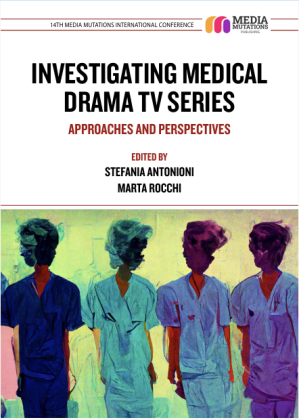
Pescatore, G. (2023). Why Medical Drama? An Interdisciplinary Study of Narrative Layers and Societal Impact. In S. Antonioni & M. Rocchi (Eds.), Investigating Medical Drama TV Series: Approaches and Perspectives. 14th Media Mutations International Conference (pp. 7-17). Media Mutations Publishing. https://doi.org/10.21428/93b7ef64.c9d8cd00