
Television’s Ecological Imprint. Serial Narratives and Environmental Awareness

Authors

Andrea Bernardelli
University of Ferrara image/svg+xml
Guglielmo Pescatore
University of Bologna image/svg+xml
Allegra Sonego
University of Bologna image/svg+xml

Synopsis

How do television narratives shape environmental awareness in the Anthropocene? This volume delves into the evolving relationship between serial storytelling and ecological discourse, exploring how contemporary television integrates sustainability, climate change, and environmental crises into its narrative structures. From dystopian science fiction to contemporary dramas, television has become a key medium for reflecting and influencing public perceptions of ecological challenges.

While serialized storytelling offers an extended framework for addressing environmental issues, it also presents inherent contradictions. The need to maintain audience engagement often leads to the personalization of systemic ecological crises, shifting the focus from collective action to individual struggles. Yet, these narratives—whether through immersive world-building, speculative fiction, or plot-driven dramas—contribute to shaping a deeper cultural consciousness around sustainability and environmental responsibility.

This collection highlights television’s dual role in reflecting and shaping the ecological crisis by weaving together perspectives from ecocriticism, media, and narrative studies. Whether subtly integrated into complex storytelling or placed at the forefront of compelling narratives, environmental themes in serial television offer a vital space for engagement, debate, and reflection on the future of our planet.
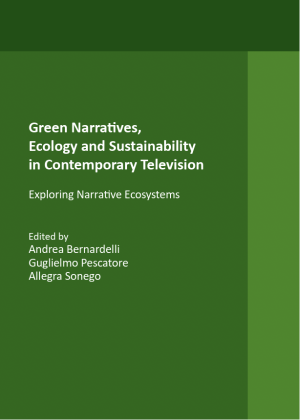
Author Biographies

Andrea Bernardelli, University of Ferrara

Andrea Bernardelli teaches Semiotics, Cognitive Semiotics, and Narratology in University of Ferrara (Italy).  He is the author of Breve dizionario di narratologia (2024), Che cos’è la narrazione cinematografica (with A. Bellavita, Roma, Carocci, 2021), Che cos’è una serie televisiva (with G. Grignaffini, Roma, Carocci, 2017), Cattivi seriali. Personaggi atipici nelle produzioni televisive contemporanee (Roma, Carocci, 2016), Semiotica.  Storia, teorie, e metodi (with E. Grillo, Roma, Carocci, 2014), Che cos’è l’intertestualità (Roma, Carocci, 2013), Il testo narrativo (with R. Ceserani, Bologna, il Mulino, 2005). 

Guglielmo Pescatore, University of Bologna

Guglielmo Pescatore is a full professor of Film and Media Studies at the University of Bologna, teaching Media Economics. He conducts nationally significant research on medical dramas and gender gaps in Italian TV series, focusing on narrative ecosystems through interdisciplinary methods. He co-authored key works, including Narrative Ecosystems (2017), The Evolution of Characters in TV Series (2018), and Modeling Narrative Features in TV Series (2022).

Allegra Sonego, University of Bologna

Allegra Sonego is a PhD student at the Department of the Arts of the University of Bologna since November 2022. She is working on a dissertation on Social themes in US medical drama within the PRIN 2020 project Narrative Ecosystem Analysis and Development Framework (NEAD Framework). A Systemic Approach to Contemporary Serial Product. The Medical Drama Case. Her latest publications are Tribunali e giustizia nelle narrazioni seriali prime-time statunitense (2022 with M. Rocchi), Covid 19: Narrative Engine and Characters Embedding (2023), and Medical Drama TV Series: A semi-systematic literature review (2024 with M. Rocchi). She is Section Editor in SERIES. International Journal of Serial Narratives.

Downloads

Published

March 5, 2025

License

Creative Commons License

This work is licensed under a Creative Commons Attribution 4.0 International License.

How to Cite

Bernardelli, A., Pescatore, G., & Sonego, A. (2025). Television’s Ecological Imprint. Serial Narratives and Environmental Awareness. In A. Bernardelli, G. Pescatore, & A. Sonego (Eds.), Green Narratives, Ecology and Sustainability in Contemporary Television - Exploring Narrative Ecosystems (pp. 5-14). Media Mutations Publishing. https://doi.org/10.21428/93b7ef64.224b84c0